| Opal
Facts
opal
, a mineral consisting of poorly crystalline to amorphous silica, SiO2•nH2O;
the water content is quite variable but usually ranges from 3% to 10%.
Common
opal is usually colorless or white, but it may be gray, brown, yellow,
or red;
the color is due to fine-grained impurities. Opal is formed at low
temperatures
from silica-bearing waters and can occur in fissures and cavities of
any rock
type. Precious, or gem, opal has a rich iridescence and remarkable play
of
changing colors, usually in red, green, and blue. This is the
result of
a
specific internal structure consisting of regularly packed uniform
spheres of
amorphous silica a few tenths of a micron in diameter; sphere diameter
and
refractive index determine the range of colors displayed.
The
greater
part of
the world's supply of precious opal comes from the Coober Pedy and
Andamooka
fields in South Australia. The original source, known in Roman times,
was in
what is now E Slovakia. Precious opal has also been mined in Honduras,
Mexico,
and the Virgin Valley in Nevada. Fire opal is a bright red transparent
or
translucent opal that may or may not show a play of color.
How Opal Produces
the 'Play of Colors'
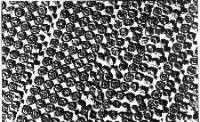 It
took the development of
the electron microscope to work this out. Precious opal is made up of
tiny
uniform spheres of transparent hard silica, which fit together in an
orderly
three dimensional frame, sitting in a "bath" of silica solution. It is
the orderliness of the spheres that separates precious opal from common
opal. It
took the development of
the electron microscope to work this out. Precious opal is made up of
tiny
uniform spheres of transparent hard silica, which fit together in an
orderly
three dimensional frame, sitting in a "bath" of silica solution. It is
the orderliness of the spheres that separates precious opal from common
opal.
Light
passes through the
transparent spheres in a direct line,
but when it hits the 'bath' of silica, it
is bent and deflected at different angles, thus producing a rainbow
effect.
Deflection
& Diffraction
Depending
on the size of the
spheres, varying colors of the spectrum are diffracted. So it is a
combination
of deflection (bending) and diffraction (breaking up) of light rays
that creates
the color in opal. If you move the stone, light hits the spheres from
different
angles and bring about a change in color. The name opal actually means
"to
see a change in color." The way in which colors change within a
particular
stone as it is rotated and tilted is called the stone's play of color.
How
color is defined.
The size
of the spheres has a
bearing on the color produced. Smaller spheres bring out the blues,
from one end
of the spectrum. Larger spheres produce the reds from the other end.
The more
uniform the spheres are placed, the more intense, brilliant and defined
the color
will be.
Glossary
of Terms:
- Amorphous
- Shapeless. Not
consisting of crystals. Non crystalline. Glass is amorphous. Sugar is
crystalline.Deflection
- The
bending of rays of
light from a straight line.
- Diffraction
- The
Breaking up of a ray
of light into either a series of light and dark bands, or into colored
bands of the spectrum.
Diffuse- To
spread out so as to
cover a larger space or surface. To scatter.
Fluorescent- A
light produced by the
electrical stimulation of a gas or vapor. Fluorescent lights have a
similar effect on opal as a bright cloudy day--they do not properly
bring out the colors in opal
Hydrate- A
compound produced when
certain substances chemically combine with water.
Incandescent- Glowing
with heat (red or
white hot) as in a light bulb which glows white hot, but produces a
light that more closely simulates natural sunlight. Sunlight and
incandescent lights bring out the natural colors in opal.
Opal- Opal
comes from the Latin
word opalus which means to see a change in color. Chemically, opal is
hydrated silica, similar to quartz.
Opalescence- A
play of color, similar
to that of an opal.
Opaque- Not
allowing light to pass
through. The opposite of transparent.
Play of Color- The
way in which colors
change as an opal is tilted in different directions.
Silica- (Silicon
Dioxide) A hard,
white or colorless substance, that in the form of quartz, enters into
the composition of many rocks and is contained in sponges and certain
plants. The needle in the mouth of a female mosquito is made of silica.
Flint, sand, chalcedony, and opal are examples of silica in different
forms.
Spectrum- The
band of colors formed
when a beam of white light passes through a prism or by some other
means (e.g. mist or spray, in the case of a rainbow) The full range of
spectrum colors are: red, orange, yellow, green blue, indigo, and
violet.
Sphere- A
round three dimensional
geometric shape whose surface is equally distant at all points from the
center point.
Translucent- Letting
light through
without being transparent.
Transparent
___ Easily seen through. (glass like)
Resources:
Some opal facts are
reproduced from www.opalmine.com.
Check out their online encyclopedia for lots more
great opal info.
Thanks to www.infoplease.com
a wonderful online encyclopedia on all subjects.
|
|